

By Edwin Mbugua, General Partner and Chief Operating Officer, Lighthouse Capital
Last updated: November 2026
Educational content, not investment advice and not an offer to sell or solicit interests in any fund.
Post-acquisition financial controls in private equity are the rules that show a new owner where the cash is and who can move it, from the day a deal closes. If you cannot see the cash, you cannot tell whether the business is getting better or worse.
This article covers three controls: a 13-week cash flow forecast, two signatures on every bank account, and a monthly close within 10 business days. It is written for limited partners (LPs, the investors in a fund), development finance institutions (DFIs, government-owned investors in private companies) and readers new to finance, in any country and at any company size.
Part of our First 100 Days guide
Read the full First 100 Days guide
See how this fits into the whole 100-day plan, in plain English: Post-Close Operational Risk in Private Equity: A Plain-English Guide to the First 100 Days.
Why financial controls come first after closing
On closing day the owner changes, but the habits do not. In many founder-run companies, one person approves payments and knows the bank logins, and the monthly accounts arrive when they arrive. A board that needs trusted numbers cannot work that way.
Finance knowledge is also thin. AlixPartners’ 2026 survey found that 66% of private equity firms say there is no chief financial officer (CFO) successor in place (AlixPartners, 2026). If the one person who understands the cash leaves, the new owner is flying blind.
From the guide: read our plain-English guide to post-close operational risk in private equity.
In plain English
Before growing a business you just bought, make sure you can see its cash and trust its numbers.
The 13-week cash flow forecast in private equity
A 13-week cash flow forecast is a week-by-week list of cash expected in and out over the next 13 weeks (about one quarter). Every week it is updated, compared with what actually happened, and any big gap is explained in writing.
- Who owns it: the company’s CFO prepares it. The deal and finance lead at the general partner (GP, the firm that runs the fund) reviews it weekly.
- When it goes live: within the first two weeks after closing.
- What feeds it: unpaid customer and supplier bills, stock and any payments to insiders.
- Red flag: an unexplained gap of more than 10% between forecast and actual cash, two weeks in a row.
13-week cash flow forecast template
Blank template: fill in weekly
| Week | W1 | W2 | W3 | W4 | W5 | W6 | W7 | W8 | W9 | W10 | W11 | W12 | W13 |
|---|---|---|---|---|---|---|---|---|---|---|---|---|---|
| Forecast cash in | |||||||||||||
| Actual cash in | |||||||||||||
| Forecast cash out | |||||||||||||
| Actual cash out | |||||||||||||
| Closing cash balance | |||||||||||||
| Gap vs forecast (limit: plus or minus 10%) |
In plain English
Write down the cash you expect each week for three months. Check it against reality weekly and explain any surprise.
Bank mandates, two signatures and payment authority
A bank mandate is the bank’s record of who may use an account. In the first days after closing, list every account on one register, check each mandate, and require two signatures (a dual signatory rule) before money leaves.
Until the board approves a delegation of authority (DOA, the written list of who can approve what, and up to what amount), set written temporary payment limits. The person who approves a payment should not be the person who sends it.
- Red flag: any bank account still on a single signature after Day 15.
- Red flag: a full DOA not signed off by Day 45.
In plain English
List every bank account, and make sure no one person can move money alone.
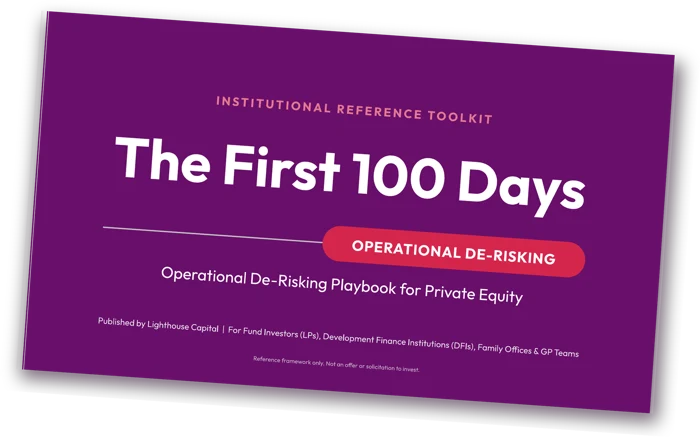
Free PDF · 18 pages
The First 100 Days LP Toolkit
12-gate scorecard, 10 manager questions and a 60-term plain-English glossary.
The 10-day close: from messy to monthly
The monthly close is finishing each month’s accounts so they can be trusted. A 10-day close means done within 10 business days of month end. Our target is three in a row by Day 100. A close over 15 business days is a red flag.
Three steps get you there. Use one standard chart of accounts (the list of categories every transaction is recorded in). Set a fixed timetable and checklist with a named owner for each task. Match the books to bank and tax records every month.
For context, APQC (American Productivity and Quality Center) reports a median of 6 calendar days to complete monthly consolidated financial statements, with top performers at 5 and bottom performers at 10, across 10,201 organisations (APQC, 2025, using 2022 data). Those are mostly established finance teams, counting weekends. For a company that has just changed hands, 10 business days is a sensible floor, not a stretch goal.
In plain English
Finish each month’s accounts within two working weeks, three months running.
The Day-30 Control Memo: proof for LPs
By Day 30, all of this goes into one short, dated document: the Day-30 Control Memo. The GP’s deal and finance lead signs it. It is the first proof an LP can ask to see.
| Control | Proof an LP can ask for | Red flag |
|---|---|---|
| 13-week cash flow forecast | Last four weekly versions with gap notes | Unexplained gap above 10%, two weeks running |
| Bank register and two signatures | Bank mandates and signatory register | Single signature after Day 15 |
| Temporary payment limits | Signed limits until the DOA is approved | Payments made outside the limits |
| Close calendar | Dated timetable and task owners | First close later than 15 business days |
Related: read our article on how the Day-30 Control Memo feeds the private equity quarterly LP reporting template.
In plain English
By Day 30, put the controls in one signed memo that investors can read.
Our view (opinion, not fact)
We think the 13-week cash flow forecast is the most useful document in the first month. It forces a look at every customer, supplier and bank account, and shows whether management and the new owner agree on reality. A GP that cannot show four weekly versions by Day 30 is, in our view, not yet in control.
More in this series
- Post-Close Operational Risk in Private Equity: A Plain-English Guide to the First 100 Days
- Key-Person Risk in Private Equity Portfolio Companies: The First 60 Days
- DFI ESG Requirements for Private Equity: The Day-30 Baseline and 100-Day ESAP
- The Private Equity Quarterly LP Reporting Template: From Day-30 Memo to ILPA-Aligned Pack
Free LP guide
Know what happens after close. Get the First 100 Days Toolkit
- 12-gate scorecard for the first 100 days
- 10 questions to ask any private equity manager
- 60 terms explained in plain English
FREE PDFFAQ
What is a 13-week cash flow forecast in private equity?
A weekly forecast of cash in and out for the next 13 weeks, checked against actual cash.
Why two signatures on every bank account?
So no single person can move money alone.
Is a 10-day close realistic for a small company?
It is a sensible first target. A fixed checklist and one chart of accounts make it reachable.
Mini glossary
- Bank mandate: The bank’s record of who can use an account.
- Chart of accounts: The standard list of categories used to record every transaction.
- DOA (Delegation of Authority): A written list of who can approve what, and up to what amount.
- Dual signatory: Two people must approve before money leaves an account.
- Monthly close: Finishing and checking each month’s accounts.
For more terms, see the glossary in our First 100 Days guide.
Sources
- 1
AlixPartners (2026)11th Annual Private Equity Leadership Survey25 March 2026
- 2
APQC (2025, using 2022 benchmarking data)Cycle Time in Days to Complete the Monthly Consolidated Financial Statements
- 3
APQC (2026)How Can You Improve the Month-End Closing Process?13 October 2026
Educational content, not investment advice and not an offer to sell or solicit interests in any fund.

Education
-MBA (Strategic Management) – University of East London
-Strategic Communications – The London School of Economics
- The Private Equity Quarterly LP Reporting Template: From Day-30 Memo to ILPA-Aligned Pack - November 20, 2026
- Post-Acquisition Financial Controls: Cash Visibility and the 10-Day Close - November 20, 2026
- Business Tech Africa – Lighthouse Capital is raising $50m - October 10, 2026