

By Edwin Mbugua, General Partner and Chief Operating Officer, Lighthouse Capital
Last updated: November 2026
Educational content, not investment advice and not an offer to sell or solicit interests in any fund.
The ILPA reporting template is a standard Excel format from the Institutional Limited Partners Association (ILPA, a global body of fund investors) for reporting fees, expenses and carried interest (the fund manager’s share of profit) to limited partners (LPs, the investors in a fund). Version 2.0 came out in January 2025. This guide explains what it contains, who has to use it, and how an LP can tell whether a manager is following it.
It is written for LPs and their analysts, development finance institutions (DFIs, government-backed investors), and first-time fund managers. You do not need to be a fund accountant to follow it. For the file itself, go straight to ILPA: we link to it below.
In plain English
The ILPA reporting template shows what an investor paid in fees and expenses, and how the manager’s profit share was worked out. It is a standard form, so reports are easy to compare.
Direct from ILPA
Get the ILPA Reporting Template (version 2.0) in Excel
The file is free and hosted by ILPA. We do not host or change it. You can also read ILPA’s own guidance and see its full list of templates.
Download the Excel file from ILPA → ILPA Reporting Template page ILPA Templates Hub
What the ILPA reporting template v2.0 covers
The template is meant to sit alongside a fund’s normal financial statements, not replace them. It adds one standard view of what an investor really pays. The numbers are shown for the individual LP, for the whole fund and for the manager, over the quarter, the year to date and since the fund began. In our own words, it has four main parts:
- The capital account statement. This is a roll-forward of one LP’s stake, from the value at the start of the period to the value at the end. It shows money paid in and taken out, fees, expenses, income and gains or losses.
- Fees, expenses and offsets. Management fees and fund costs are split into clear categories, including costs charged by the manager’s own team and costs paid to outside firms. Offsets, such as fees the manager earns from companies that reduce what the LP pays, are tracked with a running balance.
- The carried interest reconciliation. This shows how much profit share the manager has accrued, earned and been paid, and whether any has to be returned.
- The commitment reconciliation. This tracks how much of the LP’s promised money is still to be called.
A separate schedule lists fees and expense refunds that the manager or related parties received from the companies the fund owns. A footnote area at the bottom is for explaining unusual items. There is also a version for funds that invest in other funds.
Why it matters: these figures answer the first question many LPs ask: after all costs, what did this fund really charge me? For the full field list and definitions, use ILPA’s own page and its suggested guidance PDF.
Who has to use it, and from when
ILPA sets out which version applies to which fund. These are ILPA’s dates, taken from its guidance. Your own fund documents decide what is actually required, so check them.
| Version | Intended for | Starts |
|---|---|---|
| 2016 template | Funds no longer in their investment period as of Q1 2026. Managers may keep using it. | Already in use |
| Version 2.0 (January 2025) | Funds still in their investment period during Q1 2026, and funds that begin operations on or after 1 January 2026. | First delivery for the Q1 2026 period (data as of 31 March 2026) |
ILPA says the updated template is meant to replace the 2016 version going forward, and that it supplements the financial statements. Source: ILPA Reporting Template page and suggested guidance.
When the report is due
ILPA suggests a general timing framework, while the fund’s limited partnership agreement (the contract between the manager and investors) has the final say:
- Funds that invest directly: within 60 days of quarter end, or 120 days when the quarter ends at fiscal year end.
- Funds of funds: within 120 days, or 180 at year end.
- First report for a new fund: after the first full quarter once operations start, or within 18 months of the first investor closing, whichever comes sooner.
“Operations start” should match the fund’s financial statements. ILPA notes it could be the first draw on a credit line, the first call for money from investors, or the first management fee. This matters most to first-time managers, who should plan their first report well before it is due. Source: ILPA suggested guidance.
What changed from the 2016 template
ILPA lists the main changes in its guidance. In plain English:
- More detail on cash movements, such as certain upfront costs, placement fees and transfers between partners.
- Manager charges split from outside costs. Costs charged by the manager’s own team are shown apart from costs paid to third parties.
- Finer outside-cost categories, so unusual spending is easier to spot.
- The carried interest reconciliation sits inside the capital account, so profit share and values are read together.
- One level of detail for everyone. The old two-level structure is gone.
- No editing. Neither managers nor LPs may change the template. LPs may still ask for extra schedules.
In plain English
Version 2.0 asks for more detail and allows fewer changes. That makes reports from different managers easier to compare.
Which ILPA template is which
ILPA publishes several documents that people mix up. This table separates them. Links go to ILPA.
| Document | What it covers | Status (from ILPA) |
|---|---|---|
| Reporting Template | Fees, expenses, carried interest and the capital account | Version 2.0, January 2025 |
| Performance Template | Returns, worked out the same way every quarter, from a detailed cash flow history | Version 1.1, two methods (see below) |
| Capital Call and Distribution Template | The notices asking investors for money or paying money back, with a cover letter sample | Version 2.0, released September 2025 |
| Portfolio Company Template | Financial data on each company the fund owns | Being refreshed; ILPA says the final is expected January 2027 |
| ILPA Principles 3.0 | Best practice on alignment of interest, governance and transparency. It is guidance, not a form. | Published 2019, so it still refers to the 2016 template |
| Due Diligence Questionnaire | Standard questions investors ask managers before they commit | Version 2.0, updated in 2021 |
The Performance Template: two methods in plain English
The Performance Template comes in two versions. The Granular version is for managers that record the purpose of each capital call, such as an investment or a fee. The Gross Up version is for managers that do not. Both show the same fund-level and company-level results. They differ in how gross returns are built up. A manager should say which one it uses. For a new fund, ILPA expects the first delivery after four full fiscal quarters of data, with data captured from Q1 2026. Source: ILPA Performance Template page.
What Principles 3.0 says about reporting
ILPA Principles 3.0 asks managers to disclose fees, expenses and carried interest every quarter, using ILPA’s reporting standards, in enough detail for LPs to check the sums. It also lists other quarterly items: an unaudited profit and loss statement, notes on material changes, a summary of capital calls and distributions, and an explanation of any valuation changes. Annual reports should arrive within 90 days of year end with audited financial statements. Source: ILPA Principles 3.0 (PDF).
How LPs read and check a report
An LP does not need to rebuild the numbers. A few checks catch most problems:
- Does it arrive on time and in Excel? ILPA’s guidance suggests Excel over a PDF, so numbers can be checked.
- Does the opening value match last quarter’s closing value? Gaps need an explanation.
- Do the calls and payments match the notices you received?
- Are fees and offsets consistent with the fund agreement?
- How large and how well explained are the “other” lines? Unexplained “other” amounts are a flag, and ILPA asks for a description of them.
- Are unused lines filled with zeros, not deleted? ILPA tells managers to keep all fields.
- Does the carry reconciliation make sense next to the fund’s valuation changes?
- Is there company-level evidence? The template is about fund-level costs, so operating facts must come from elsewhere.
Free download
LP Report Review Scorecard
A short scorecard for checking a manager’s quarterly report: 12 checks scored 0 to 2, five tie-out tests, and 10 questions to send the manager. Aligned to ILPA guidance.
This is why a manager should never treat the ILPA template as the whole report. It covers what the fund charges. It does not tell an LP how each company is run, whether cash is controlled or whether key people are in place. For those topics see our articles on post-acquisition financial controls, key-person risk and DFI ESG requirements.
How it connects to the first 100 days
A good first report is not written at quarter end. It builds from dated documents produced in a fund’s first 100 days, such as a Day-30 control memo and a Day-100 scorecard. The fund-level numbers follow ILPA. The company-level evidence comes from the manager’s own trackers and cash forecasts. Our article on the private equity quarterly LP reporting template shows how to build that pack step by step, including an open remediation log for reporting bad news early.
Read the full guide: see the Post-Close Operational Risk in Private Equity: A Plain-English Guide to the First 100 Days for how the whole 100-day plan fits together.
In plain English
ILPA sets how fees and returns are reported. How each company is actually doing is up to the manager to show.
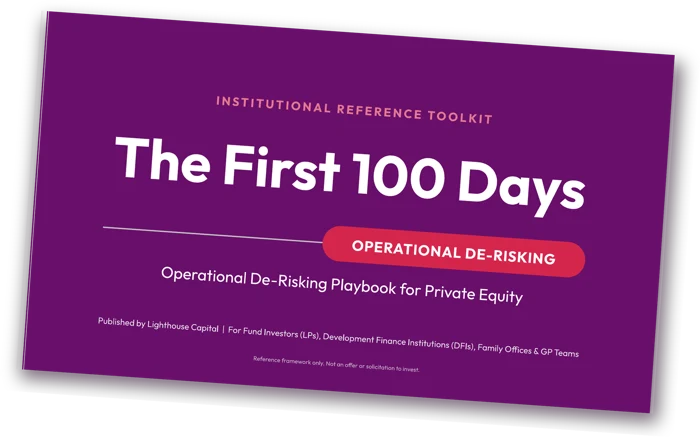
Free PDF · 18 pages
The First 100 Days LP Toolkit
12-gate scorecard, 10 manager questions and a 60-term plain-English glossary.
Our view (opinion, not fact)
We think the standard template is a floor, not a finish line. A manager that fills it in cleanly, explains every unusual line in the footnotes and adds honest company-level evidence is easier to trust than one that only meets the minimum.
FAQ
What is the ILPA reporting template?
It is a standard Excel format from ILPA for reporting fund fees, expenses and carried interest to LPs. Version 2.0 was released in January 2025 and replaces the 2016 version for newer funds.
Where can I download the ILPA reporting template in Excel?
ILPA offers it free on its own site. Use the direct Excel link or the ILPA Reporting Template page. We do not host the file.
What changed in the ILPA reporting template 2.0?
It adds more cash-flow detail, separates manager charges from outside costs, splits outside costs more finely, puts the carried interest reconciliation inside the capital account, uses one level of detail and no longer allows edits.
Who has to use the new ILPA reporting template, and from when?
ILPA intends it for funds still in their investment period during Q1 2026 and for funds starting operations on or after 1 January 2026. The first delivery is for Q1 2026. Check your own fund documents and side letters for what is required.
What is the difference between the ILPA reporting template and the performance template?
The reporting template covers fees, expenses, carried interest and the capital account. The performance template covers returns, built from a detailed history of cash flows.
Are the ILPA Principles the same as the ILPA template?
No. The Principles are best-practice guidance on alignment, governance and transparency. The template is a form. The Principles ask managers to report fees using ILPA’s standards.
Mini glossary
- Capital account statement: A record of one investor’s stake in a fund, from opening to closing value.
- Carried interest: The manager’s share of fund profits.
- Offset: A fee the manager earns elsewhere that lowers what the LP pays.
- QTD, YTD, ITD: Quarter to date, year to date and since the fund began.
- Granular and Gross Up: The two ways of building gross returns in the Performance Template.
- LPA: The limited partnership agreement, the contract between manager and investors.
For more terms, see the glossary in our First 100 Days guide.
More in this series
- Post-Close Operational Risk in Private Equity: A Plain-English Guide to the First 100 Days
- Post-Acquisition Financial Controls: Cash Visibility and the 10-Day Close
- Key-Person Risk in Private Equity Portfolio Companies: The First 60 Days
- DFI ESG Requirements for Private Equity: The Day-30 Baseline and 100-Day ESAP
- The Private Equity Quarterly LP Reporting Template: From Day-30 Memo to ILPA-Aligned Pack
Lighthouse Capital is not affiliated with ILPA. Our references to ILPA templates mean “aligned to ILPA guidance” and do not imply endorsement. ILPA templates and guidance are copyright ILPA, all rights reserved. Lighthouse Capital is currently raising Fund I.
Sources
- 1
- 2
- 3
- 4
- 5
- 6
- 7
- 8
- 9
Educational content, not investment advice and not an offer to sell or solicit interests in any fund.

Education
-MBA (Strategic Management) – University of East London
-Strategic Communications – The London School of Economics
- Environmental and Social Management System (ESMS): What LPs Should See Before They Commit - November 21, 2026
- IFC Performance Standard 1 (PS1) Explained: How LPs Test a Fund Manager’s E&S Risk System - November 21, 2026
- The ILPA Reporting Template Explained: What LPs Expect in a Quarterly Pack - November 21, 2026